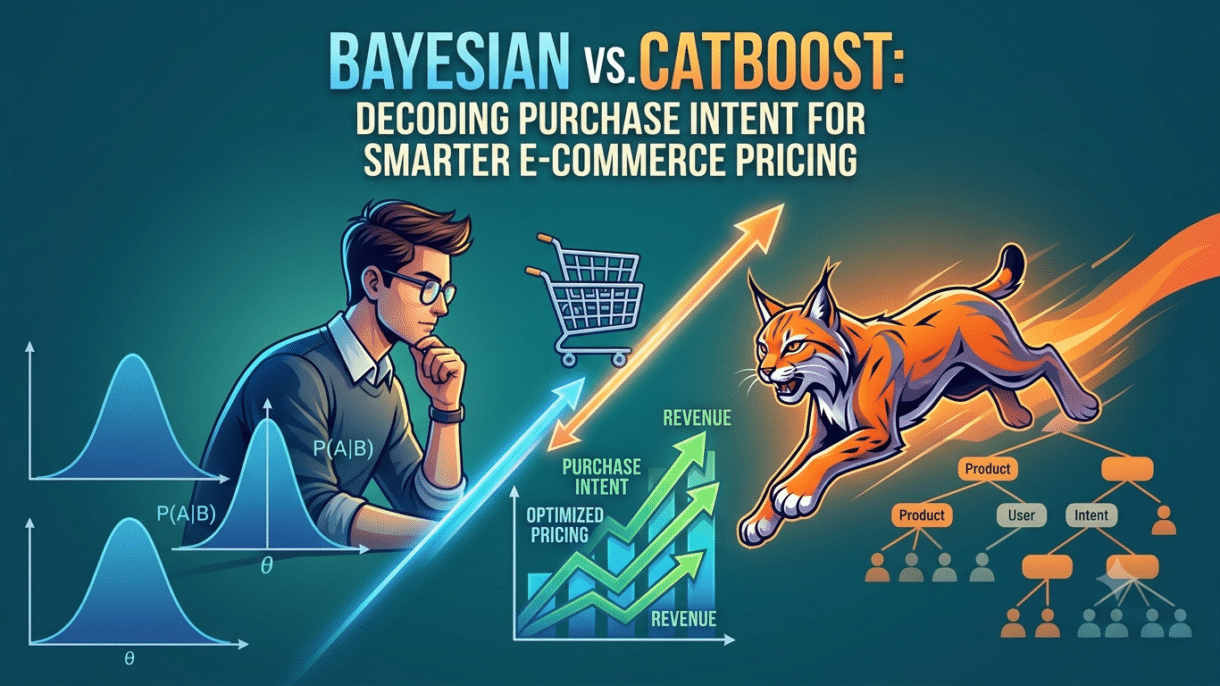

Many pricing tools look at what people do. But that is not enough. To price well, we need to know why they do it. That is called purchase intent. If we miss it, the model might guess wrong and lose sales.
CatBoost and XGBoost are fast and reliable, great for getting results quickly. But they do not explain how decisions are made. Bayesian models take a different path
- Slower to train
- Faster to run
- Built to show how each signal connects
This article walks through both types of models and shows you what happens when you really pay attention to intent. The result? More conversions, better margins, and pricing that just feels fairer all around.
Why Purchase Intent Recognition Is the Missing Link in Dynamic Pricing
The Problem with Behavior-Only Models
Most pricing tools stop at clicks and carts, but pricing is not just about what people do; it is about why they do it. A person may be curious or comparing prices. They might be checking shipping costs before leaving.
If your model treats all actions the same, it starts learning from a lot of noise. That leads to problems like:
- Overfitting: The model reacts to patterns that do not lead to sales.
- Mispriced offers: Giving discounts to people who were not going to buy. Serious buyers get ignored.
- Wasted margin: Giving incentives where they are not needed. It cut the profits.
For a business leader, this means lost revenue, weaker margins, and frustrated customers.
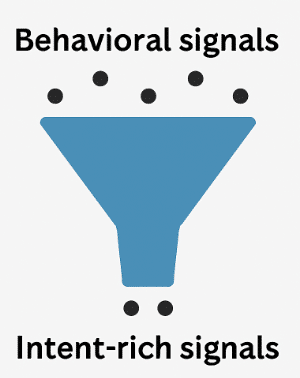
This funnel graphic shows how broad behavioral signals (such as clicks and views) are filtered down into a narrower, more focused stream of intent-rich signals.
Why Intent Recognition Is Non-Negotiable
Intent recognition helps you:
- Intent recognition filters out noise and highlights users who are close to converting. Ignore casual browsers who are not likely to convert.
- Use models to spot buyers: set prices that match their intent, not just their behavior.
It is not just a nice-to-have. If you care about pricing that works, intent is non-negotiable. Better signals = better pricing.
Current Landscape: CatBoost and XGBoost Dominate, But Are They Enough?
Most pricing models use machine learning to monitor user behavior. CatBoost and XGBoost are popular and fast to deliver accurate results. But pricing now needs intent, not just speed. Are they still enough?
CatBoost for Intent Prediction
CatBoost handles clicks, views, and cart data well. It is designed for structured user behavior.
- It handles categories natively: You do not need to preprocess things like product type or user segment. It reads them as-is.
- It is strong on tabular data: It finds patterns in shopping data when you add time or session details.
- It is good at identifying intent: CatBoost can distinguish between casual browsing and serious buying. It can tell who’s ready to buy.
CatBoost is the most accurate for data with user intent. LightGBM and XGBoost are faster, but difficult to explain.
Here is a comparison table:
The takeaway is clear: Speed alone is not enough; pricing models must also explain their decisions.
| Model | Accuracy | Speed | Handles Categories | Easy to Explain |
| CatBoost | High | Medium | Yes | Medium |
| LightGBM | High | Fast | No | Low |
| XGBoost | Medium–High | Fast | No | Low |
XGBoost: Fast, But Hard to Read
XGBoost is fast. It is good for big datasets and quick updates. But it is not easy to explain.
- It Learn fast: It is good for frequent updates.
- It has built-in regularization: It prevents the model from overfitting to messy data.
- It is difficult to explain: You can’t tell which part of the data is helping.
- It misses small clues: Like who’s just browsing and who’s ready to buy.
Behavior alone is not enough. Pricing needs to understand intent, not just what users do. You need models that explain their decisions, not just make guesses. That is where intent-aware tools help. And where older models start to fall behind.
The Bayesian Alternative: Precision, Interpretability, and Speed.
Why Bayesian Programming Is Criminally Underused
- They show their work: Bayesian models do not just give answers. They explain how they got there. Every prediction is supported by clear logic.
- Fast when it is deployed: Bayesian models run quickly once deployed and, unlike black-box models, show exactly how signals connect.
- Accurate and clear: They are as accurate as CatBoost, but easier to explain.
- Built for intent: Bayesian models use fewer but smarter inputs to tell who is browsing and who is ready to purchase.
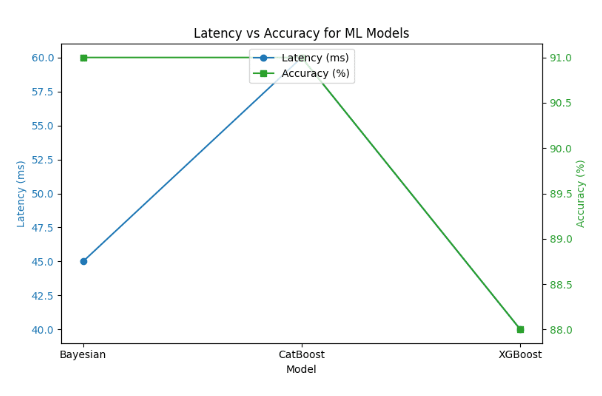
Latency vs accuracy comparison
You need to know:
- Bayesian: It combines speed with clarity. It is always easy to understand. It is built for real-time pricing.
- CatBoost: It provides high accuracy. But runs slower and is difficult to explain.
- XGBoost: It is the fastest. But it may miss small signs of intent.
Your Experience: Matching Top Models with Bayesian Estimator
- Benchmarked against top models: It is tested against CatBoost and LightGBM. It is also benchmarked with XGBoost. They perform well in pricing and conversion.
- Trust leads to better decisions: When teams understand the model, they trust the output. Quicker setup. Fewer mistakes.
- External proof: Claude.ai ran Bayesian estimators on real datasets. The results were strong and easier to explain.
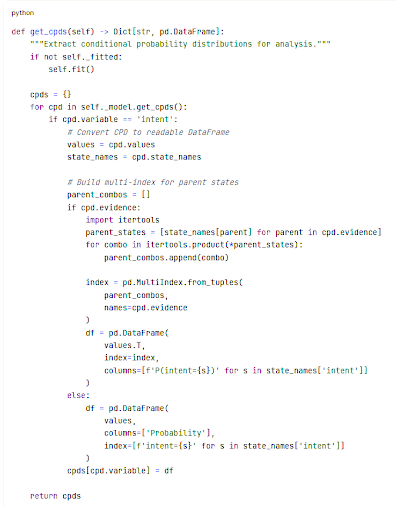
Now that we have compared traditional ML models with Bayesian approaches, let us see how these ideas come together in practice with MarginBoost.
Inside MarginBoost: A Framework for Intent-Aware Pricing
What Is MarginBoost?
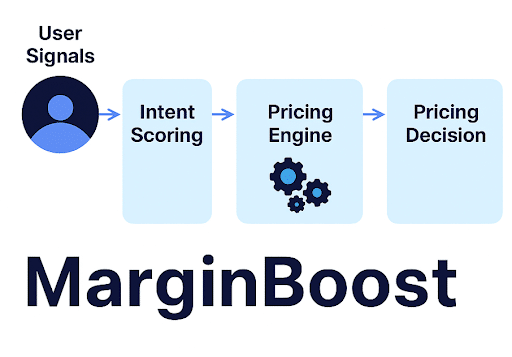
MarginBoost is your in-house framework that spots buying intent using Bayesian logic.
At Flexiana, we developed MarginBoost, built to be fast, simple, and easy to explain, with a pricing module powered by Bayesian Optimization.
It works by combining:
- CPTs to map user behavior
- Mutual information to find what matters most
- Marginal effects to adjust prices with precision
It does not need tons of data. Just the right signals.
Architecture diagram of MarginBoost
Real-World Use Case
Challenge: Too many users were dropping off. Pricing did not match intent.
Fix: MarginBoost flagged high-intent users and adjusted prices in real time. The results speak for themselves.
Outcome:
- 30% better pricing precision
- Fewer users leaving
- More conversions
DIY Guide: Build Your Own Bayesian Intent Estimator
Setup Instructions with pgmpy
We can integrate this for you, but if you would rather build it yourself, here is how to get started:
To build and train your Bayesian model, start by setting up your environment with the pgmpy library.
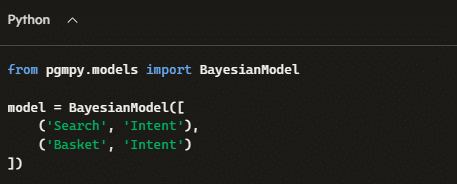
- Import libraries and define the model
Use BayesianModel to connect user actions to intent. For example:
- Detect key user attributes
Track the more important behaviour:
- Traffic source
- Search use
- Filtering actions
- Basket activity
- Checkout behavior
- Shipping research
- Purchase history
These signals help your model tell who is just browsing and who is ready to buy.
Training and Validation
- Split your data: Use 80% of the data to train your model. Use 20% of the data to test intent prediction.
- Enable adaptive pricing: Keep training the model so it stays in sync with changing user behavior.
Training Pipeline Flowchart
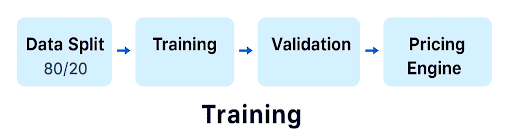
For decision-makers, the takeaway is that Bayesian intent models can be deployed with minimal data and deliver immediate business impact.
Understanding What Matters: CPTs and Signal Strength
These tools do not just crunch numbers; they give teams clarity on which signals truly drive purchases.
Conditional Probability Tables (CPTs)
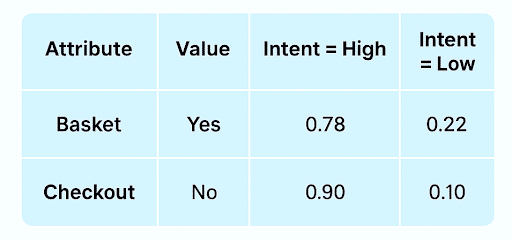
CPTs help you understand each user’s behavior that affects intent.
Conditional Probability Tables (CPTs) are like cheat sheets for understanding what your users are up to. Once you train your Bayesian model, you get a table for every input. Each one spells out how likely someone is to buy based on what they do, like tossing things in their cart or skipping the search bar entirely.
This aids in identifying patterns:
- Patterns start to jump out. If someone is filtering by price, chances are they are ready to buy.
- Starting checkout means they are about to buy.
- If they are double-checking shipping info, maybe they are still confused.
Basically, CPTs turn all that behavior into numbers you can actually use. No more guessing games, you know exactly which actions matter most.
CPT matrix for top attributes
Mutual Information
See which actions actually matter
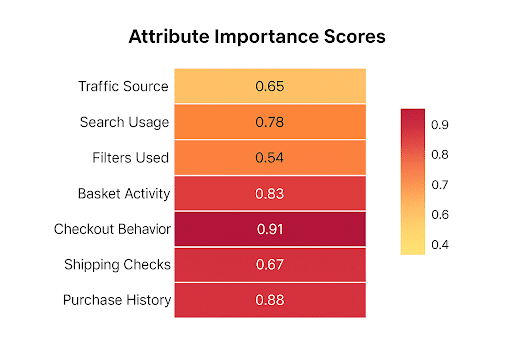
Mutual information shows how much one behavior tells you about another. In this case, how much a user action tells you about their intent to buy.
The higher the score, the stronger the link.
For example:
- “Added to cart” usually has a high score: It is closely tied to buying
- “Scrolled the homepage” has a low score: it does not say much
This helps you rank behaviors by impact. So you can stop guessing and focus on the signals that actually matter.
Heatmap: Attribute Importance Scores
Sensitivity Analysis
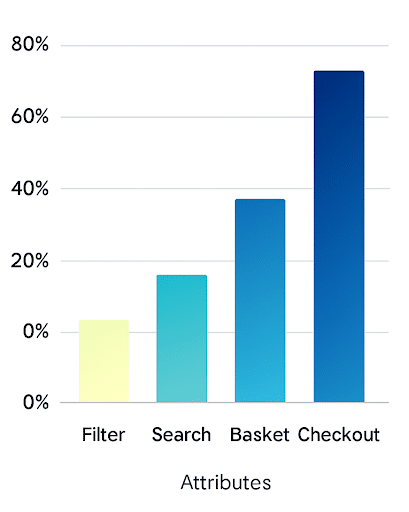
Change one user action and see how predictions shift. Change just one thing, maybe where your traffic is coming from or what happens during checkout. Also, check how the model responds.
It is a quick way to spot which moves make the biggest difference, and where a few small changes can really boost your results.
Impact Chart of Attribute Shifts on Intent Probability
Marginal Effects
Marginal effects show how one action changes the chance someone will buy.
It looks at two situations:
- When someone does the action (like using filters).
- When they do not.
Then it shows how much that difference affects the result.
For example:
- “Added to cart” might increase the chance of buying by 40%.
- “Scrolled homepage” might not change much.
This shows which actions are important and which ones are not.
Table: Marginal Effect Scores Across User Behaviors
| User Behavior | Marginal Effect |
| Added to Cart | +40% |
| Started Checkout | +35% |
| Used Filters | +15% |
| Used Search | +5% |
| Scrolled Homepage | ~0% |
Structural Dependencies: Seeing the Network Behind Intent
Bayesian Networks Reveal Hidden Relationships
Think of Bayesian networks as maps of intent; they do not just predict, they reveal the hidden pathways behind user behavior.
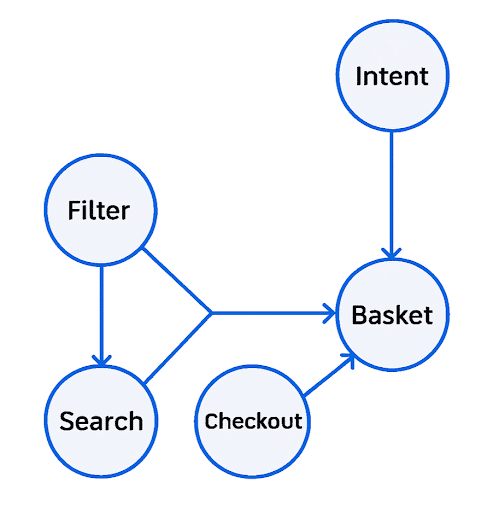
Bayesian networks do not just predict, they explain as well. They show how user behaviors connect or overlap. They also show the ones that stay independent.
You can see:
- Actions that affect intent directly.
- Behaviours that work only when paired with others.
- How dependencies appear in the network.
This helps you understand the full structure along with the result.
Directed Acyclic Graph of Attribute Dependencies
Implications for Feature Selection
When you know how features interact, you can:
- Remove extra ones.
- Keep the important ones.
- Make the model work better.
Less data. Better guesses. Clearer thinking.
Putting Bayesian Models into Action
To use your model in real systems, follow these steps:
- Save the model: Use tools like joblib or pickle to store it.
- Build a service: Wrap the model with a simple app using
- FastAPI
- Flask
- Cloud function
- Create an API: Add a /predict route so other tools can send data and get results.
Simple Example
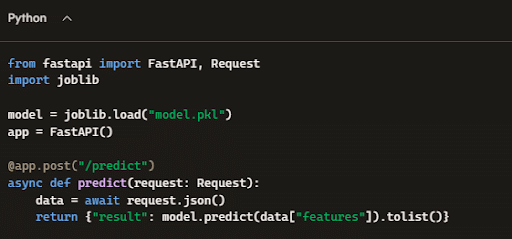
This setup lets your model make real-time predictions. Use it for pricing and recommendations. It also works for other real-time tasks.
Integration Options: Plug MarginBoost into Your Stack
MarginBoost works with any setup. It is easy to connect.
API-Ready Modules for Real-Time Scoring
- It scores user behavior in real time. It works during search and browse. Also runs at checkout.
- Its endpoints are fast and simple.
- It handles high traffic without decreasing speed.
- It connects easily to your data layer or CDP.
It works with Top E-Commerce Platforms.
- It works with Shopify and WooCommerce. Also supports Magento.
- It supports custom stacks like React and Next.js.. Also works with Vue.
- It integrates smoothly with headless storefronts.
- It is compatible with most tag managers and event pipelines.
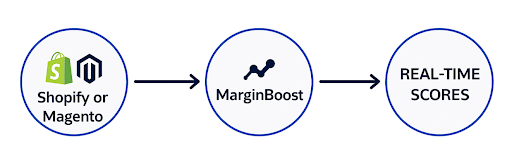
Integration flow with Shopify/Magento
How MarginBoost Works with E-Commerce Platforms
MarginBoost integrates seamlessly with major platforms like Shopify, Magento, and WooCommerce, giving you real-time pricing and intent scores as your customers shop.
Here is what it looks like:
- First, someone browses a product or heads to checkout. That action triggers the process.
- Next, the store sends MarginBoost the product ID, some user signals, and whatever is in the cart through an API call.
- MarginBoost jumps in, crunches the numbers, and returns a score, say, how likely the person is to buy, or what price might seal the deal.
- The store takes that info and reacts right away, maybe by changing prices but not more than the last displayed price, making a new offer, or suggesting related products.
Let’s look at an example.
Someone adds a high-margin product to their cart on Shopify. MarginBoost spots this and says, “Hey, this person’s likely to buy.” The store immediately pops up a bundle deal or an upsell, based on that shopper’s intent.
Custom vs Off-the-Shelf Deployment
Deployment Options
We handle setup and tuning. We also take care of testing.
Use our open-source starter kit. It comes with scoring logic and wrappers. Also includes platform adapters.
Quick Setup and Clear Results
- Implementation is typically completed within a week.
- It needs minimal engineering time.
- It gives instant insight into high-intent users.
Note-
They say setup takes less than a week, but let’s be real- it depends on how complex your platform is and how ready your data is. Sometimes, getting everything up and running takes a couple of months. It is smart to start with a pilot first. That way, you can see how it works before rolling it out everywhere.
Keeping Your Model Up to Date
To maintain accuracy, your model needs regular updates:
- Retrain often: Update each month to match changing seasons and habits.
- Watch for data changes: If user behavior changes, your model might start making mistakes. You need to identify it early.
- Track updates: Save each update of the model so you can compare results or go back if needed.
Off-the-shelf tools do not offer this control. Custom models can let you control everything, so you stay proactive.
Fair Pricing That Builds Trust
If dynamic pricing is fair, it can be beneficial. It is not a strategy to change rates just because someone is in a hurry or is not aware. It is taking advantage.
Fair pricing uses real signals. To get it right, teams require models they can explain. If you know why a price was set, you can catch problems and fix them. That helps keep pricing fair.
Bayesian models are transparent, so you can show your pricing is not unfair to anyone based on location, age, or what device they are using. When people see how things work, they trust you more. And that trust? It keeps them coming back.
In the long run, ethical pricing is not just the right thing to do. It is a good business.
Conclusion- Bayesian Models Are the Future of Intent-Aware Pricing
In digital business, pricing involves more than simply numbers. It is important to identify ready buyers and know the motivation behind their purchase. Indeed, human behavior can be predicted by machine learning models such as XGBoost and CatBoost. But they do not explain the reasons. They are correct, but they are like a black box.
That is changed by the Bayesian model. They show everything important to users. When data changes, they quickly adapt and handle uncertainty. You can therefore base pricing on actual intent compared to only monitoring clicks or views.
This is not just another upgrade. It is a shift toward pricing that reflects how people actually think and buy. At Flexiana, we believe Bayesian models are the future of intent-driven commerce.
If you want fast and clear pricing based on real insights, choose Bayesian models.
The Future of Intent-Driven Shopping
Bringing the Pieces Together
- Intent modeling identifies when someone is ready to purchase.
- Generative AI creates customized offers and messages instantly.
- Recommendation engines are moving from fixed lists to more personalized suggestions.
These tools will work together as one system. They guide each user journey based on what they are likely to do next.
Early Signs of Change
- Personalized discounts: Prices change based on
- User actions
- Urgency to buy
- loyalty
- AI-driven negotiation: In response to indications from the buyer, intelligent agents instantly modify offers.
- Customer lifetime value optimization: Retention strategies are designed with high-value users in mind.
It is Important Because
- Good timing means more sales
- Smart pricing protects profit
- Personalized paths keep users coming back
E-commerce will move from fixed groups to flexible paths customized according to users’ behavior. Clicks, pauses, and visits become signals. These signals help systems learn and adjust automatically.
Reference Links
Model Comparisons and Performance
- CatBoost vs XGBoost: Detailed Comparison – ML Journey
- Understand CatBoost vs Other Boosting Algorithms – StudyRaid
- Benchmarking Gradient Boosting Algorithms – arXiv
Bayesian Models in Pricing
- Bayesian Methods in SaaS Price Testing – Monetizely
- Bayesian Persuasion for Dynamic Pricing – arXiv
- Bayesian Optimization for E-Commerce Pricing – European Advanced AI Journal