

Choosing between a startup incubator and an accelerator is a big decision for any founder. It can shape your whole startup journey. The path you select affects the speed of your business growth and who invests in you. It also affects the kind of support you get along the way. It is not just about joining a program but choosing the right help for where you are.
Many founders are confused about these two terms, but startup incubators and accelerators are for different stages. Incubators are for early-stage ideas, while Accelerators are for startups ready to grow fast. Both deal with different problems and play an important role at various points.
You might be wondering: What does an incubator do? How does an accelerator work? Which one fits your startup right now?
So do not rush. First, understand what Incubators and Accelerators really offer before you commit.
This guide breaks it all down, so you can choose with confidence.
Why This Choice is Significant
Early-stage startups get more support, so there is no need to build everything alone. You will get early guidance from grants and mentors. Shared workspaces and investor programs help you grow. The tools are also there to help you. A lot of entrepreneurs still struggle to distinguish between accelerators and startup incubators. One aids in the development of a concept and the other aids in its development.
Early-stage startups fail because they choose the wrong startup incubator program. CB Insights found that more than 70% of failed startups made strategy mistakes.
If you are growing too fast, especially with the wrong accelerator, you have more chances to fail. So, growing at the right pace matters.
Choosing between a startup incubator and an accelerator isn ot just about money or support. It is about timing. If you choose wrong, it can slow you down. When your growth is fast, and pressure is high, your right decision matters.
What Is a Startup Incubator
Definition & Purpose
A startup incubator helps early ideas grow. It is for entrepreneurs who are still figuring out,
-
- What to build
- Who it is for
- How the business should work
An incubator for entrepreneurs gives you time. You get shared workspaces and basic admin help, as well as guidance from experienced mentors. It is a place to test your idea and shape your model. Start small before growing or raising money.
How Do Startup Incubators Work
An incubator for entrepreneurs supports new founders over time. It runs for 6 to 24 months and gives space to test ideas and fix what is not working. You do not have any pressure regarding the deadline.
Most incubators are linked to nonprofits and universities. Some also get support from government programs. Their goal is not to earn profit, but to help new businesses get started.
Here is what the incubator offers:
-
- Flexible timelines so you can go at your own pace
- Shared space to meet other startups
- Help with legal and accounting basics
- Advice from experienced founders and experts
These programs help solo founders or small teams with clear steps.
For more detailed information about a startup incubator, read: What is a Startup Incubator and how does it help Founders?
Pros & Cons
Pros
|
Cons
|
What Is a Startup Accelerator?
Definition & Purpose
Accelerators are short programs that mostly run 3 to 6 months. Some are shorter, but their focus is speed. You work hard and move fast with weekly check-ins, mentor sessions, pitch practice, and demo days.
Accelerators aim to grow fast, so they focus on three things.
-
- Scaling: You built a product, and now it is time to grow. Accelerators help you find customers, hire well, and expand without breaking down.
- Fundraising: Most startups join to raise money and learn how to pitch. They also connect with investors who can fund them.
- Product-market fit: Accelerators help you to prove your product and show demand. They test if people will pay, and decide whether to scale or pivot.
The Equity Trade
Most accelerators take equity, usually 5-10% of your company. In return, you get funding that could be $20k or $150k, depending on the program. You get mentorship and customer connections, and the network continues even after the program ends. Some founders hate giving up equity, but if it helps you raise money or get customers, do it.
Who It is For
Accelerators are not necessary for every startup. They are employed by businesses or startups that are already making progress. It is time to scale now that you have developed something, attracted users, and tested your concept.
If you are still not ready about what you want to build, an accelerator is not right for your startup. Start with an incubator startup. If you want to grow fast, you need help from an accelerator.
Typical Structure
Fixed Cohorts
You join 10–30 startups in a fast and focused 3–6 month program. You will learn, compete, and grow together as one team.
Weekly Structure
Your weeks are busy, and most programs follow a set pattern.
-
- Early in the week, mentors help solve problems, make plans, and discuss funding.
- Mid-week brings group sessions on growth and hiring, along with coverage of legal and sales topics.
- At the end of the week, you share key metrics, user growth, revenue, and highlight what is working.
Some programs need you to relocate, while others are remote.
Demo Day
After months of work, you pitch to investors on Demo Day, held in a venue or online where hundreds of VCs, angels, and funds gather. You get 3 to 5 minutes to tell your story, show traction, share your vision, and answer questions. Deals often happen here; some startups receive term sheets immediately, while others secure meetings that later turn into funding. Not everyone raises money on Demo Day, but it is still the best chance to reach serious investors all at once.
What You Get
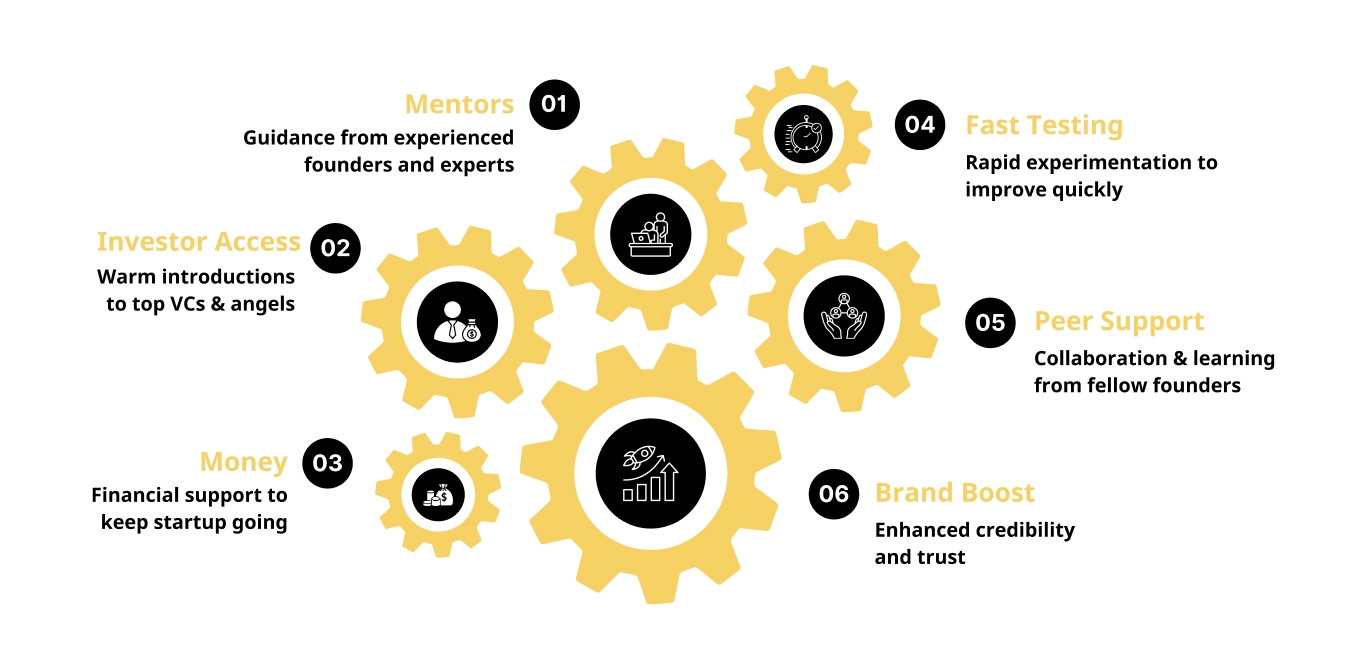
- Mentors: Founders who have built and sold startups. Investors and experts from top companies like Google and Airbnb. They understand what you are going through.
- Investor access: Get warm introductions to top VCs and angels, as cold emails mostly get ignored, but these intros lead to real meetings.
- Money: Most offer $25k to $150k, just enough to keep going. Some help you raise more during or after the program.
- Fast testing: You test everything, whether it is a product, message, price, or customers. Move and learn fast to improve quickly. You can turn months of work into weeks.
- Peer support: Your group becomes your crew, where you learn what works, share tips and contacts, and gain the best ideas from other founders.
- Brand boost: Big names help you gain credibility. Investors listen, customers trust, and people want to be part of it.
Pros & Cons
Pros
|
Cons
|
Startup Incubator vs Accelerator: Know the Differences
|
Feature |
Startup Incubator |
Startup Accelerator |
|
Startup Stage |
Just an idea or starting out |
Product or MVP already built |
|
Program Length |
6 to 24 months |
3 to 6 months |
|
Pace |
Slow and flexible |
Fast and intense |
|
Funding |
Little or none |
Often includes seed money to grow |
|
Affiliation |
Linked to nonprofits or universities |
Supported by private firms or VCs |
|
Focus |
Start strong or grow fast |
Foundation first or quick scaling |
|
Support |
Workspace and admin help. Mentorship and expert guidance. |
Mentorship and investor access. Pitch preparation and guidance. |
|
Best For |
Founders just starting out |
Teams that are ready to grow fast |
|
Investor Pressure |
Low |
High |
|
Structure |
Flexible and few deadlines |
Structured, with clear steps and deadlines |
Which One Is Right for You
You can choose it based on three things.
- Your stage
- Your goals
- Your team’s readiness
|
If You’re Just Starting
A startup incubator program is the best option to choose. |
If You’re Ready to Grow
An accelerator is the best option to choose. |
Before You Apply, Ask About These Areas
Startup Fit
-
- What kinds of startups do you usually accept?
- Do you stick to certain industries or stages, or is it open?
- How many startups actually make it into each cohort?
Funding & Equity
-
- How much funding do you give?
- What’s your standard equity take?
- Are there any random fees or surprise costs founders should know about?
Mentorship
-
- Who are your mentors- what’s their background?
- Do they help with things like building the product, hiring a team, or raising money?
Program Structure
-
- How often do you check in with founders?
- What does a typical week look like?
- How long does the whole program run?
- Is it fully online, in-person, or hybrid?
Growth & Exposure
-
- Will I get to meet investors or connect with partners through you?
- What’s your Demo Day format?
- Can you share any stories of startups that did really well after your program?
Performance & Expectations
-
- How do you track progress or measure success during the program?
- What do you expect from founders, both while they’re in the program and after they finish?

Conclusion
Before you join any startup incubator program, ask the important questions. It is not only about money or the benefits you get, but whether the program fits your work style and your needs. Get a sense of the structure and the people. See how involved the mentors really are. A good program should match your stage and goals, and how you build.
The Field Group’s startup incubator is for founders who want to build a successful business. It is built for early-stage teams that need structure and clarity and want to grow with a clear path. Instead of focusing on pitch decks, we help you build the business behind the pitch. We support your product, finances, team, and operations. You will work with experienced operators and get access to capital networks when you are ready.
Whether you are shaping your first MVP or gearing up for a raise, we will help you move forward.
https://fieldgroupny.com/startup-incubators-vs-accelerators-pros-cons-and-key-differences/